
Where Juvenile Detention Center Releases Go
A youth may leave the Juvenile Detention Center for a legal guardian, remain held pending a hearing, or transfer to state placement or a Kansas juvenile correctional facility. Each outcome is controlled through juvenile authorities and the court. None should be inferred from an adult Sheriff roster.
The official county juvenile facility page describes those general destinations without offering a public youth roster. That boundary is deliberate. Release to a guardian is not the same as state placement, and movement to another juvenile custodian is not community release.
Bond and recognizance usually point toward community release under court-set terms, but the booking row remains the event evidence. A bond figure or court order alone is not a door-out time. Sentence completion may be followed by supervision or another case. If the location or type suggests transfer, identify the receiving system before drawing a conclusion.
Confirm a Juvenile Detention Center Release
Only an authorized person should seek a named youth’s status. Public adult tools are not a fallback for confidential juvenile information.
- A legal guardian should contact the facility through the information supplied for the youth’s case.
- Counsel should use the juvenile court and case channels available to authorized participants.
- Ask whether the youth remains detained, was released to a guardian, or moved to state placement.
- Do not post or republish a youth’s name, photograph, or case detail from an adult search workflow.
- Follow the facility’s identity and authorization checks.
The broader Johnson County released-inmate search and records guide explains how to switch to KASPER for KDOC, the BOP locator for federal prison custody, or ICE’s current-detention locator after a documented handoff. No result in one outside system proves community release.
Juvenile Detention Center Records Contact
Call the facility for a time-sensitive physical-status question. Request an archived Sheriff-created record from Central Records. The two functions are related but not interchangeable.
915 W. Spruce Street
Olathe, KS 66061
913-715-7200
Central Records accepts requests in person, by email, or by mail. Its phone is 913-715-5460 and its email is SHR-Recordrequests@jocogov.org. The office is in the Sheriff’s Operations Building at 27747 W. 159th Street, New Century, and lists weekday hours from 8 a.m. to 5 p.m., excluding holidays. Ask the records office, rather than the front-line facility, for a copy of an existing booking and release record.
Juvenile Detention Center Facility Role
The Johnson County Department of Corrections operates this secure 40-bed facility for youth ages 10 through 17. Young people may stay while awaiting a hearing, a guardian release, or state placement. The facility is not the Sheriff’s adult jail and should never be described as one.
Its place in the county map is important because a family may know only that a youth entered county custody. Yet the adult release framework stops at this boundary. Juvenile court rules, protected records, authorized guardianship, and youth-specific placement decisions control what may be confirmed and to whom.
Juvenile Status Questions
There is no verified public Johnson County juvenile release field inventory. The useful questions are therefore posed through authorized channels, and the answers may remain restricted. A public page should describe the process without promising access to a named child’s record.
| Field | What it answers |
|---|---|
| Current placement | Whether the youth remains in secure detention or another authorized setting. |
| Guardian release | Whether the court and facility authorized return to a legal guardian. |
| Hearing status | Whether a pending juvenile court event controls the placement. |
| State placement | Whether custody continued through a youth-specific receiving authority. |
A displayed row is historical. It does not rule out a later arrest. Likewise, a current roster miss can reflect a transfer, spelling mismatch, delayed data, or no Johnson County booking. Use the event fields instead of treating absence as proof.
Request Juvenile Detention Center Records
For a record outside the visible daily window, ask narrowly for the existing booking and release or custody-event record. Give the full name, approximate booking date, and booking number or CFN when known. Request the release date and time, type or authority, location, and receiving agency if the exit may have been a transfer. A focused request helps the custodian locate the right event without being asked to create a new narrative.
The Sheriff lists no printed-report charge for the first five pages and $0.35 per page after that. Staff search, review, and redaction time is charged at the employee’s hourly rate. Payment is due in advance. These published terms do not promise that every record is available or that every request will be completed in three days. Kansas law calls for a response by the end of the third business day when immediate access is unavailable, with a reason for delay and an expected date.
Protecting Johnson County Youth Records
Juvenile confidentiality is not a gap to work around. It is the controlling access posture. Adult booking-photo, offender-registry, and released-inmate assumptions must not be imposed on a child. Sealed or restricted information should not be reconstructed from cached pages, social posts, or third-party material.
A guardian or lawyer may have access that the public does not. Facility staff can require proof of identity and authority before sharing status. The court may limit the documents available online or at all. Those limits should be respected even when a person’s general placement destination can be described.
View Juvenile Detention Center Information
The county’s Juvenile Detention Center page is the official source for the facility’s purpose and general release destinations.
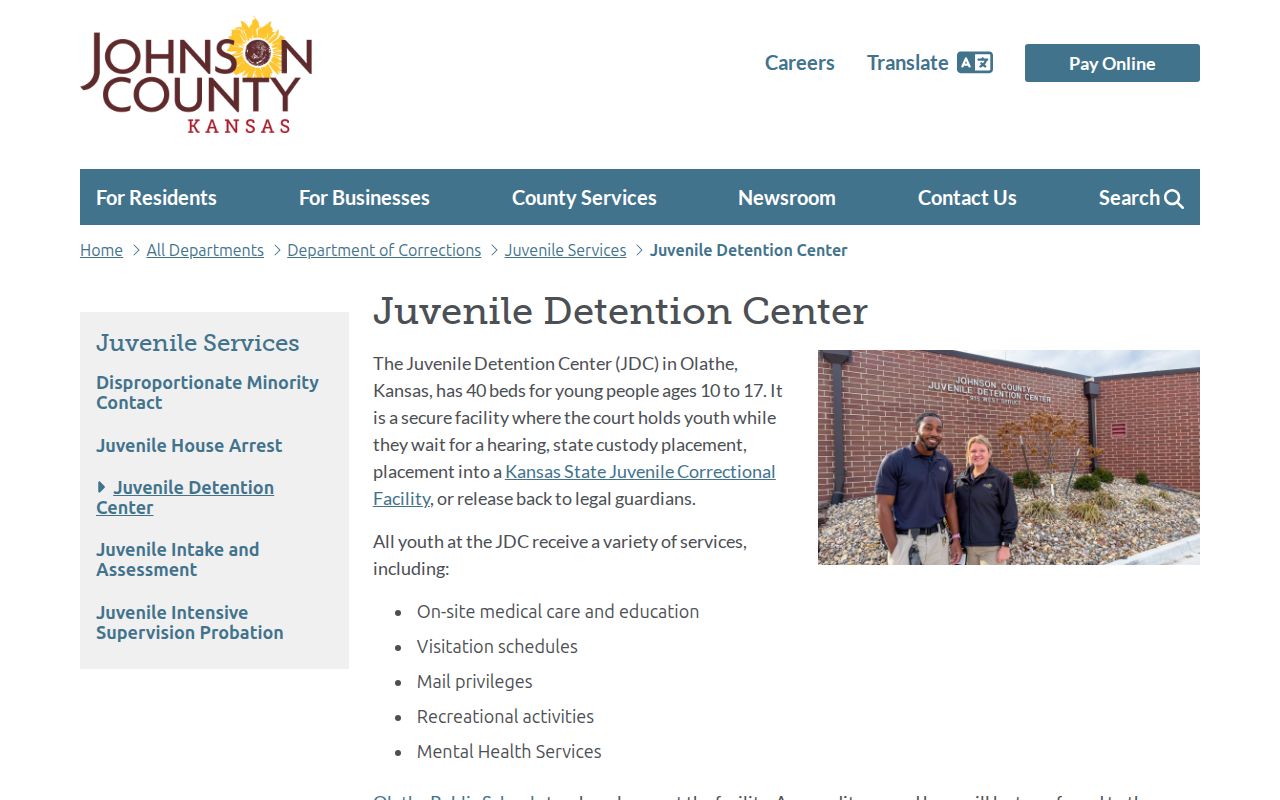
The official page supports the careful route used here: general facility facts may be public while a named youth’s status remains protected.
A negative adult search has no useful meaning for a youth. It cannot establish guardian release, state placement, continued detention, or even whether the spelling and identity were correct. The safe course is to use the juvenile case channel available to an authorized guardian or counsel. Facility staff, not a public adult database, can explain what proof of authority is required.
The same rule applies to photos. The public-record discussion for adult inmate and releasee photographs does not erase juvenile confidentiality. No youth image should be pulled into an adult booking example, used to test a public portal, or copied from a social source. The facility is listed to explain where youth custody occurs, not to create a public name or photo index.