
Johnson County Projected or Actual
KASPER uses the exact label “Earliest Possible Release Date.” It is prospective. A future date with an Incarcerated status means prison custody continues. The date may reflect the controlling sentence, lawful credit, forfeiture, programs, sentence changes, consecutive cases, and sometimes Prisoner Review Board action.
An actual Johnson County jail release is different. The Sheriff records a release date and time, type, and location after the custody event. Those fields help show community exit or transfer. A later KASPER Parole status shows departure from prison with supervision, while Discharged is stronger evidence that the KDOC obligation ended.
Find Johnson County Projected Release
Begin with custody type, not the person’s home county. A Johnson County booking does not automatically create a KDOC record, and a prison sentence is not controlled by the county jail.
- For a pretrial detainee, check the Johnson County court case for bond, recognizance, dismissal, or other authority, then confirm physical exit with the Sheriff.
- For a county sentence, obtain the sentence, jail credit, and custody-event record from the court and Sheriff Central Records.
- For a Kansas prisoner, open KASPER and search by KDOC number or offered identity fields.
- Read “Current Status reported by Dept. of Corrections” with “Earliest Possible Release Date,” convictions, admission, and location.
- For an indeterminate sentence, review parole eligibility and Board action. An upcoming hearing does not show approval.
- After the date passes, confirm the event through KASPER status, the Sheriff release row, or an agency record.
The Johnson County released-inmate record path adds court, county, and federal checks when the custodian is unclear.
Kansas Good-Time Release Credit
K.S.A. 21-6821 generally limits good time to 15 percent of the prison portion for crimes committed on or after July 1, 1993. Specified lower-severity groups in later statutory date ranges permit 20 percent. Covered sentences may also receive up to 120 days for qualifying program completion. Credit must be earned and may be withheld or forfeited.
The “85 percent” phrase is arithmetic based on a maximum 15 percent credit. It is not universal and never guarantees a date. A covered 20 percent group may approach 80 percent. Off-grid, life, mandatory, pre-guidelines, special sex-offense, and consecutive sentences can differ. K.S.A. 22-3725 supplies an older structure for crimes before July 1, 1993.
Read the sentence and offense date. A charge label alone can miss the controlling crime, mandatory period, later order, or consecutive term. KASPER is the better public starting point because it reflects KDOC’s current record, though the field can change.
Johnson County Earliest Possible Date
The Kansas label signals an earliest outcome under current assumptions, not a door-out appointment. KASPER notes that Board action and good-time or program credit can affect it. This wording must be preserved when recording the result.
For determinate guidelines sentences, KDOC says timing is predetermined subject to 15 to 20 percent credit, while the Board sets supervision conditions. Indeterminate sentences depend on parole eligibility and suitability. K.S.A. 22-3717 contains offense- and date-specific exclusions and mandatory periods.
Eligibility permits consideration only. Board terms include Parole, Continue, and Pass. Parole reflects suitability, Continue calls for more work or information, and Pass denies parole for a stated period. Physical release may still follow later while plans and conditions are set.
Why Johnson County Dates Change
A date is a snapshot. Some events change the sentence computation. Others leave that term intact but block community release.
| Factor | Effect |
|---|---|
| Good-time credit | Earned credit can reduce the covered prison portion. |
| Credit forfeiture | Lawful loss can move the earliest date later. |
| Program completion | A qualifying sentence may gain added credit within the cap. |
| Court amendment | A later order can change the term or jail credit. |
| Consecutive cases | One term may end while another continues. |
| Board action | Eligibility does not ensure parole approval. |
| Detainer or transfer | Another county, KDOC, USMS, or ICE may take custody. |
KASPER updates each working day and is not a complete justice history. Contact KDOC when a date is urgent or the entry appears wrong.
Johnson County Jail Release Timing
County custody uses another evidence chain. A bond order, sentence, dismissal, or probation order explains authority. The Sheriff’s release timestamp shows when processing ended. A bond amount does not prove payment, and a court order does not prove all holds cleared.
Central Booking and New Century share the Johnson County Booking and Release Report. It warns of an approximate four-hour delay. For a fresh event, call the facility. For an older event, use Previous Booking History, then request the custody-event record.
Release type and location matter. Transfer to KDOC, another county, USMS, or ICE ends Sheriff custody at that site but is not community release.
Johnson County Central Records accepts requests in person, by email, or by mail. A focused request should identify the person, approximate booking date, and booking number if known, then ask for the existing booking and release or custody-event record. Request the release time, type, authority, and receiving agency when a transfer is possible. Narrow wording helps the custodian locate the right record and separates a projected court outcome from the final physical exit.
Johnson County KASPER Date Source
The official KASPER entry explains state coverage, limits, and its working-day update pattern.
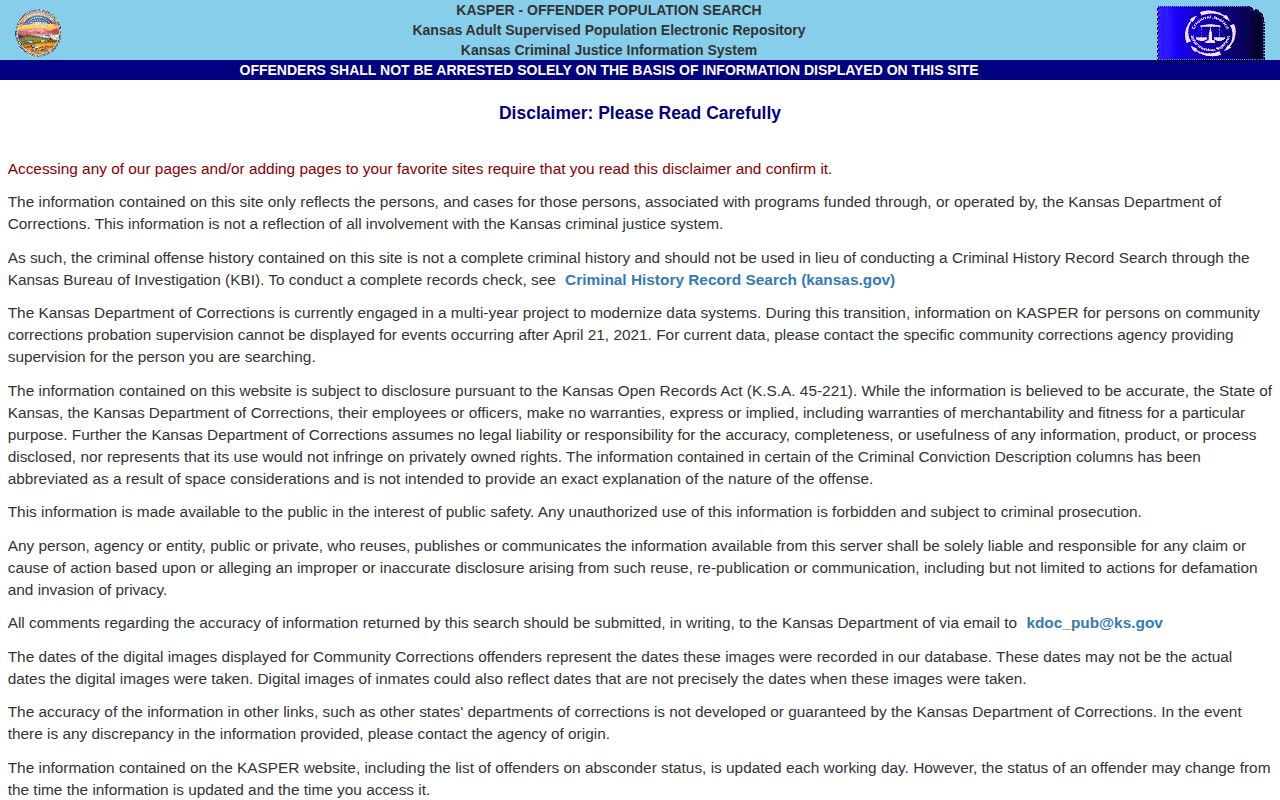
The matched offender detail, not this gateway screen, supplies the exact status and earliest possible date.
Confirm Johnson County Actual Release
Confirmation occurs after the event. For prison, read later KASPER status and contact KDOC when a record is needed. Parole means prison release into supervision. Discharged means the KDOC obligation ended. Neither resolves an unrelated hold.
For county jail, use the Sheriff timestamp, type, and location or direct facility confirmation. Kansas VINE can send a county-jail alert, but it excludes KDOC prison offenders. The Johnson County VINELink inmate search explains that boundary.
Federal cases require the matching source. BOP can show a Release Date and Location “RELEASED,” but that does not exclude supervision or another custodian. ICE’s locator focuses on current detention.
When court and custody records differ, ask each source only about the fact it created. Johnson County District Court can explain the bond order, sentence, jail credit, amendment, dismissal, or revocation. The Sheriff can confirm when its processing ended. KDOC can explain the KASPER calculation and later state status. This division avoids treating a judge’s legal authority as the door-out time or asking the county jail to interpret a state prison date.
A no-result also needs care. A county-only case may never appear in KASPER. A KASPER record may omit parts of a broader history. A person who reached a projected date may have transferred, started another term, or entered supervision. Record the source, date viewed, exact label, and current status so later changes can be understood without overstating the original result.
Parole hearing records require the same restraint. The Kansas Prisoner Review Board publishes monthly public-comment schedules and listed offenders who may become eligible afterward. The list can show commitment name, KDOC number, case data, offense, and county of offense. County of offense means the conviction county, not Johnson County residence or planned supervision. No official person-level public decisions database was located, so a calendar appearance cannot be described as approval.
If a named decision is important, seek a releasable Board record tied to the KDOC number, hearing month, and case, or confirm later through KASPER and KDOC. A Parole outcome indicates suitability, yet actual release can follow later after planning and conditions. Continue means more deliberation or information is needed, while Pass denies parole for a stated period. These terms can shift the likely timing without creating an actual release timestamp.
Older and unusual sentences deserve special care. Life, off-grid, mandatory, pre-guidelines, and consecutive terms do not fit a quick percentage shortcut. The controlling judicial sentence, crime date, applicable statute, and corrections calculation must be read together. If a record seems inconsistent, ask KDOC to explain its own entry instead of privately recalculating a promised release date.
The most reliable conclusion states both proposition and source: KASPER predicts a Kansas prison date, the court authorizes a county release, and the Sheriff records the physical county exit.
Note: A projected release date does not prove actual release; confirm the later event with the agency that held the person.
Public Record Search
Sponsored Results